Strolling or Loitering?
For all you students of Walter Benjamin, here is a little thought-prompt on display at Logan Airport in Boston.
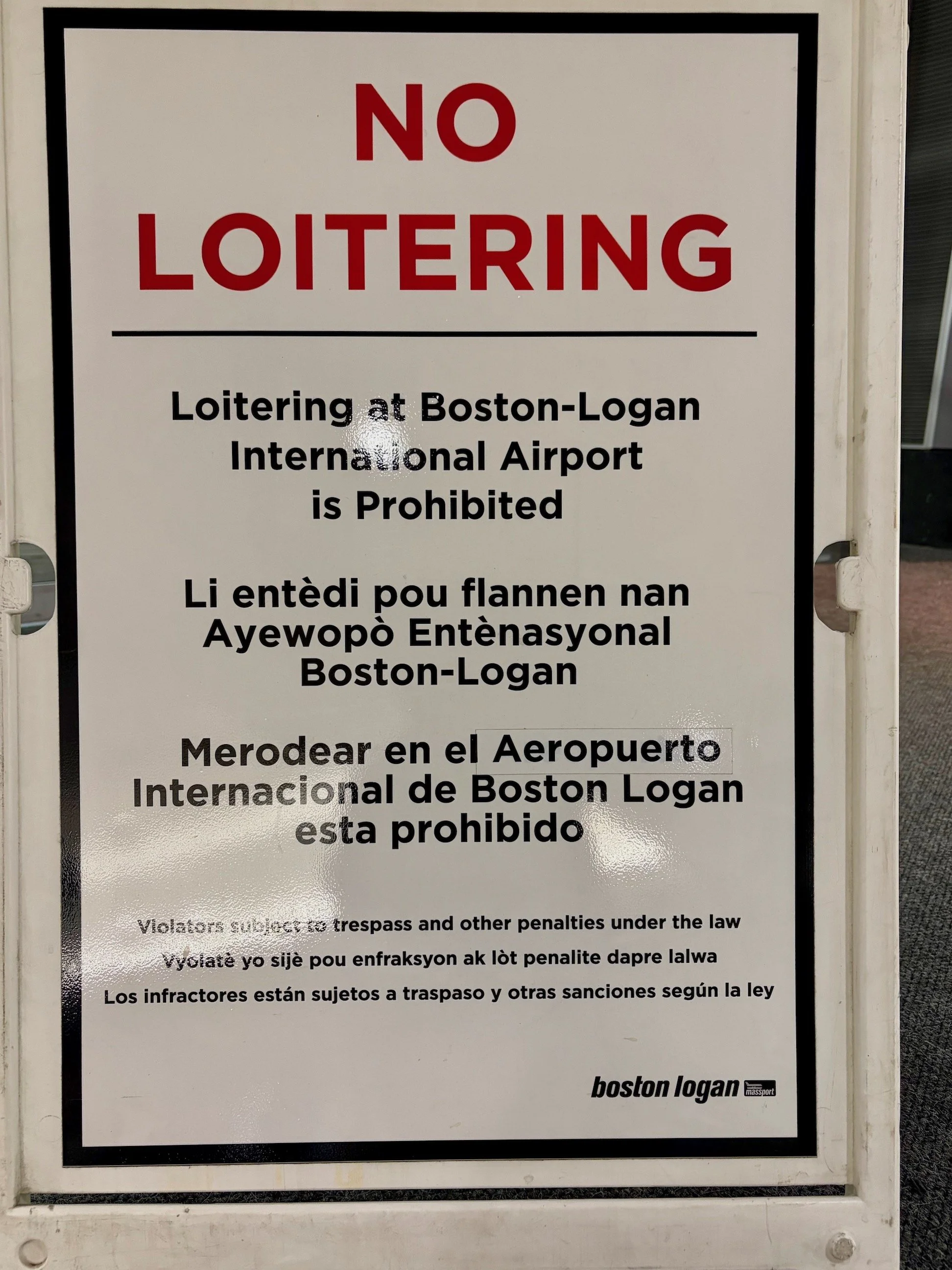
The main message in English is addressed to “Loiterers”, repeated in the English text below the headline. In the UK and US loitering with intent is an offence so the word does have some heavy connotations. The English Vagrancy Act of 1824 (following the Napoleonic Wars) and the Vagrancy Act of Virginia of 1866 (following the Civil War) come to mind. We’ll come back to that. In the Creole however we see the word “flannen” which I suppose must be the verb form (2nd person plural?) of the French noun ‘flâneur’. Apart from the grammatical issues which I leave for others to sort out, there is the philosophical one equating the infinitive ‘flâner’ with ‘to loiter’.
Surely a flâneur is much more than a loiterer, or perhaps more specifically, a loiterer with criminal or anti-social intent to whom the Massport admonition is aimed. A flâneur really has no intent at all other than to absorb the atmosphere. Is this an offence? If that is the case where are the Massport Thought Police? Of course one could disguise loitering without intent, a suspicious thing in itself in the eyes of those committed to productive effort at all costs, by pretending that one has (productive) intent by simulating a waiting pose for someone arriving on a plane that doesn’t exist — the Marie Celeste arriving from Nirvana International, delayed. But with an eye on the small print at the bottom, lawyers may define such a pretence as ‘violation’ or ‘trespass’.
The entire sentence translated from the Creole reads: “it is forbidden to wander around Boston Logan International airport”. Isn’t wandering around — to stroll, to saunter, to wander around aimlessly — exactly what Benjamin had in mind as the role and purpose of a flâneur? On the most prosaic level, hanging out at the airport is one of the great fields in which to practice flânisme, people-watching in a specialised form of the arcade. To take the edge off waiting for a delayed arrival, one can spend many an enjoyable hour guessing who has arrived from where, who is related to whom, what nationality they might be and in the mescladis that is the United States, whether they are coming or going, existentially speaking. Doctors and business professors are now telling us that boredom is a healthy condition. What is flânisme if not creative three- or four-dimensional boredom?
Baudelaire, quoted by Benjamin, talked of the “gastronomy of the eye”. It is too easy to translate that into a ‘feast for the eyes’ but really airport people-watching is more like visual grazing, a less intense and less intentional drawing of a boundary between boredom and some morsel of interest.
The Spanish text however, at the bottom of the sign, gives the interdiction a more urgent and threatening feel. Merodear translates as ‘to prowl’. Why is it the Spanish that have such a threatening word supposedly congruent to the pleasant wandering / wondering that we infer from Creole? It cannot be the current socio-political demonization of one particular group over another in today’s USA — can it? Prowling, I concede, is generally not a good thing in an airport, or anywhere else for that matter. It implies threatening behaviour, the sort that ICE agents are trained to assume. So, yes, absolutely no prowling, I agree.
We have now come far from el flanismo, the idea of wandering or strolling, soaking it all in, enjoying the crowd, the bustle, watching the embraces, savoring the rattle of tiny wheels and even, in this most blissful of idle moments, wondering whether the Massport copywriter, perhaps a PhD in philosophy, may have missed out on The Arcades Project.
Notes taken while waiting for a plane to arrive from Seattle, 13 April 2026 HM.