Optimism and a limitless world
Montanchez
On the sierra above the hilltop town of Montanchez in western Spain there is a large stone, a menhir, two or three times the height of a person, precariously balanced on another stone embedded in the ground. The signs to this extraordinary natural phenomenon refer to “el cancho que se menea” (the rock that wobbles). You get to this rocky outcrop by walking up through a matoral of white and yellow broom and scrub oaks, a cow pasture populated by Limousin and Charolais and some local indigenous breeds. At the top, at 980 meters above sea level and almost 300 meters above the town, there is a forest of masts, essential infrastructure for radio, television and the internet.
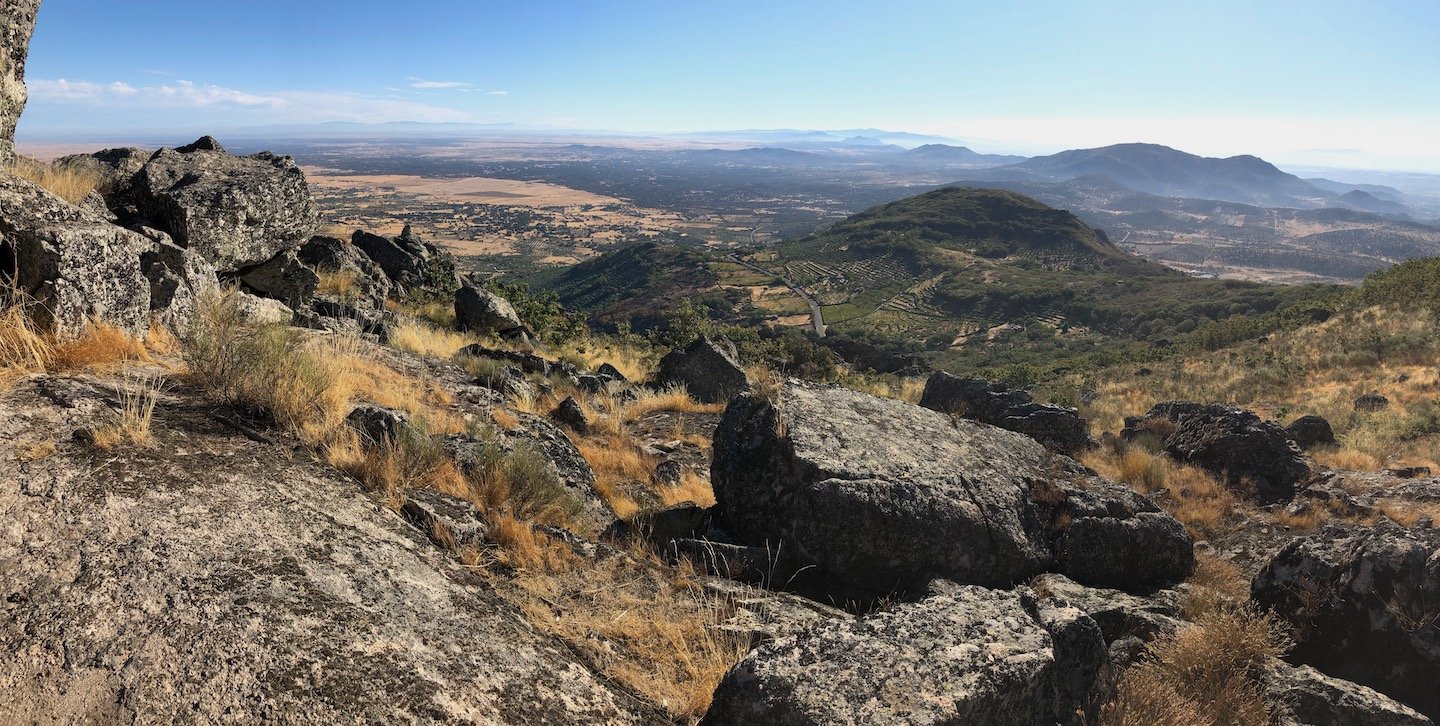
A view north from the ridge of the Sierra de Montánchez photo: Hubert Murray
A few meters to the north and slightly downhill from the masts, there is the famed ‘cancho que se menea’. Apart from the spectacle of the wobbling rock apparently balanced on end, there is a stupendous view.
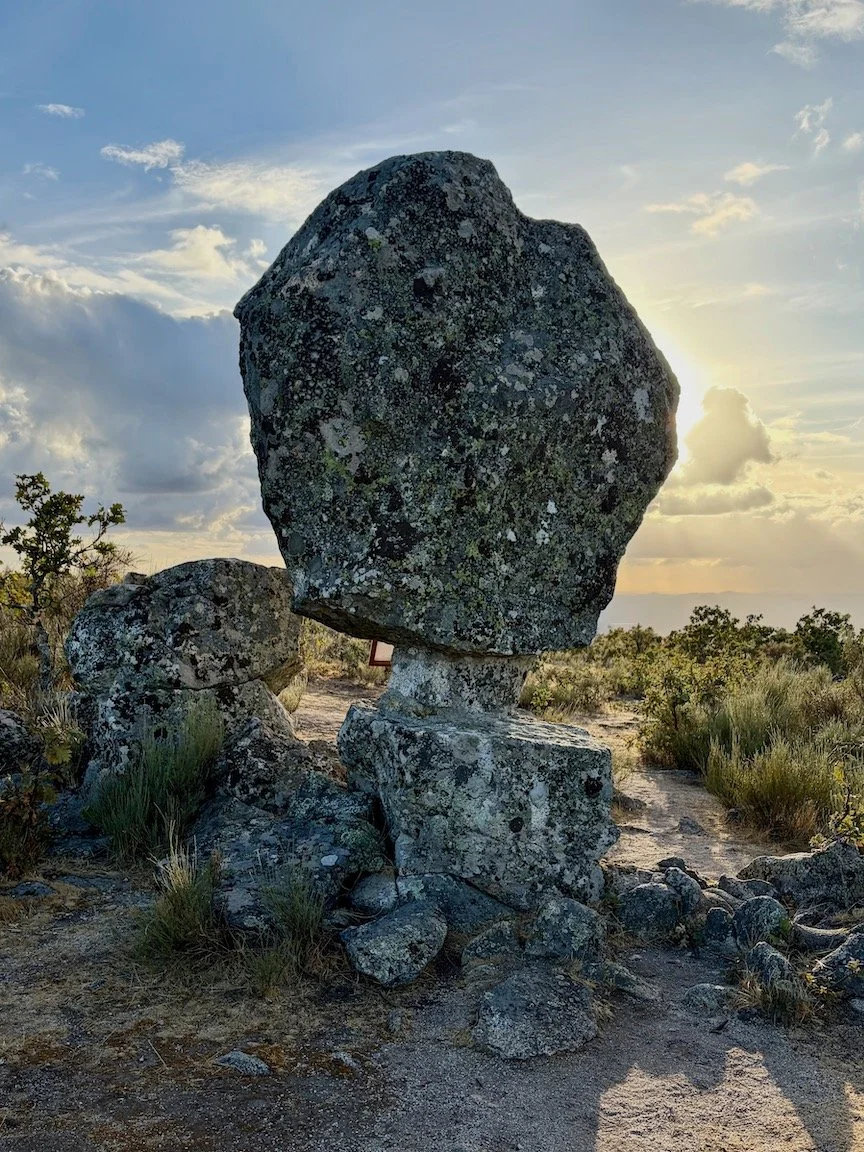
El cancho que se menea photo: Hubert Murray
But then, focusing on the original purpose of this walk up to the top, we see that there is a helpful history and explanation to be read.
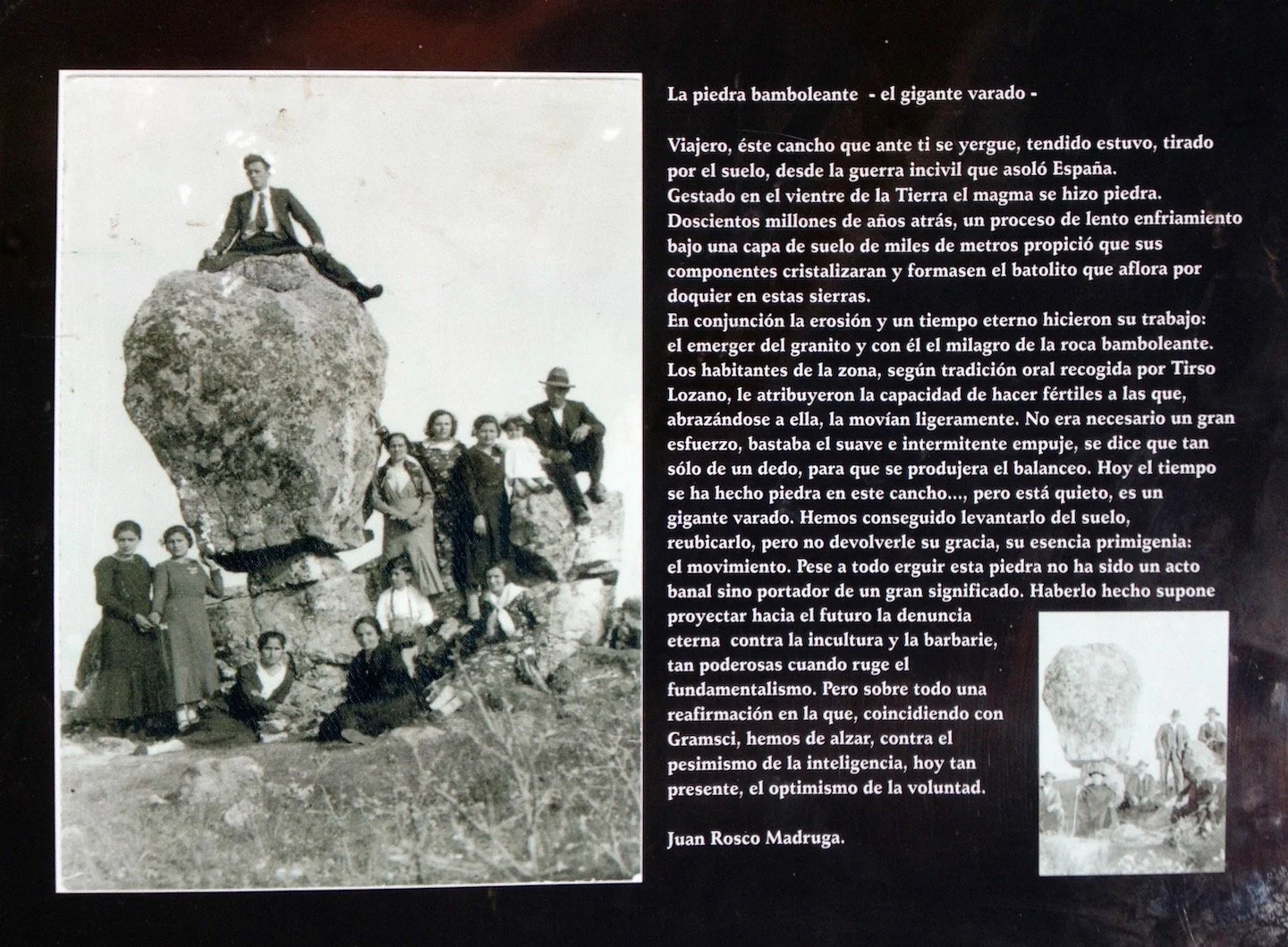
An earlier information plaque photo: Hubert Murray
Here it is, in translation:
The Wobbling Stone — The Stranded Giant
Traveler, this boulder that stands before you lay prostrate, sprawled on the ground, since the civil war that ravaged Spain.
Grown in the womb of the Earth, magma turned to stone.
Two hundred million years ago, a slow cooling process beneath a layer of soil thousands of meters thick allowed its components to crystallize and form the batholith that outcrops everywhere in these mountains.
In conjunction, erosion and time itself did their work: the emergence of the granite and with it, the miracle of the wobbling rock.
The inhabitants of the area, according to oral tradition collected by Tirso Lozano[i], attributed to it the power to make those who, embracing it, moved it slightly, fertile. No great effort was necessary; a gentle, intermittent push, it is said, just from a finger, was enough to produce the swaying motion. Today, time has turned to stone on this rock… but it stands still, a stranded giant. We have managed to lift it from the ground, relocate it, but not restore its grace, its original essence: movement. Despite everything, raising this stone has not been a trivial act but one imbued with great significance. Having done so means projecting into the future the eternal denunciation of ignorance and barbarism, so powerful when fundamentalism roars. But above all, it is a reaffirmation in which, echoing Gramsci, we must raise, against the pessimism of the intellect, so prevalent today, the optimism of the will.
Juan Rosco Madruga
An explanation for the explanation is necessary. The stone was toppled by Franco’s Nationalist forces on 19thJune 1937. It was restored to its original position on 31st August, 2013 [ii]. As noted in the historical text, the town failed “to restore its grace, its original essence: movement”. Young couples will now have to look elsewhere for assistance in fertility. Gramsci’s invocation of the optimism of the will — striving for, and anticipating, a better world — has unfortunately been tested by a subsequent defacing of the two last sentences.
Marvao
Just over the border into Portugal, Marvao is another fortified hilltop town, named for Ibn Marwán the Muwallad chieftain who in AD 876–877 took refuge on the high granite peak during a rebellion against the Emirate of Córdoba. There he built a walled settlement that was successful in defending itself against hostile forces until, almost three hundred years later, it was taken over between 1160–1166 by the Christian king Afonso Henriques.
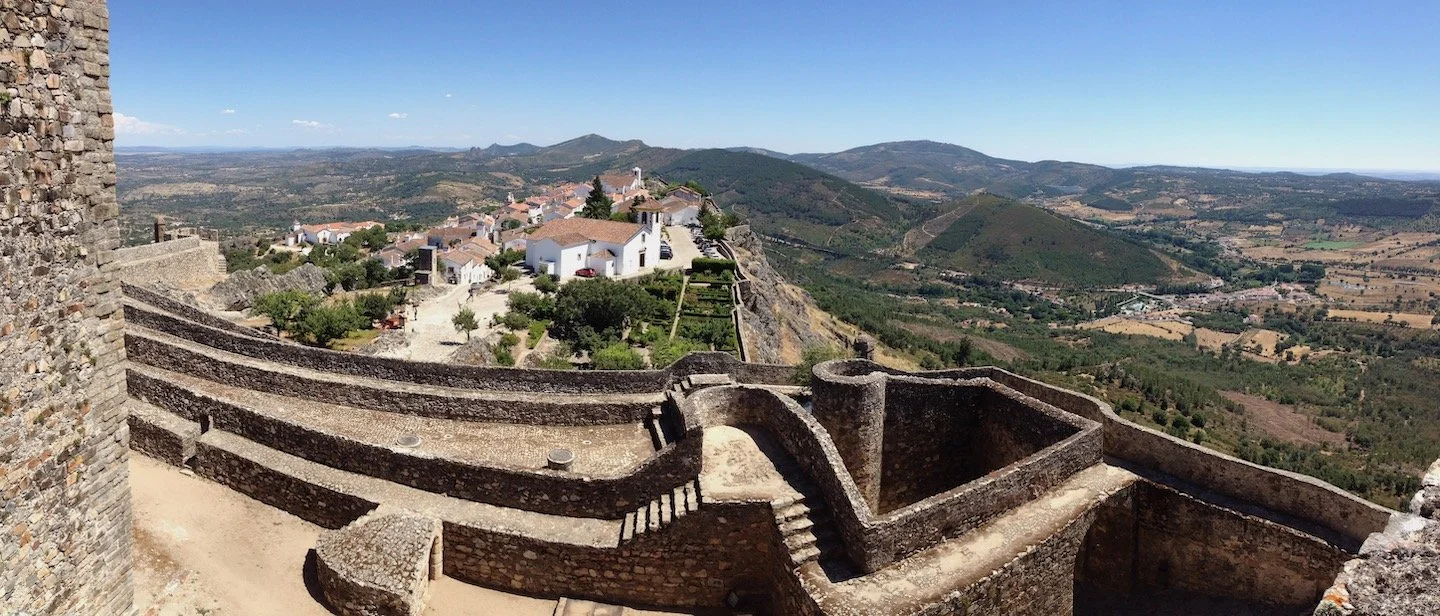
Marvão, view of the village from the castle photo: Hubert Murray
The architecture of the town is spectacular, its siting on a hilltop overlooking fertile plains even more so. Since it was built to resist siege, a cavernous cistern under the castle proper contained sufficient water to support the population for six months. Cattle were driven into the castle courtyard and every house subsisted on preserved food to wait out the siege.
At the entrance to the modern village, attuned to the tourist trade, there is a scale model of the castle and village of Marvao, cast in bronze. This is the work of Maria Leal da Costa [iii], a renowned sculptor in Alentejo with studios in Marvao and other parts of the country.
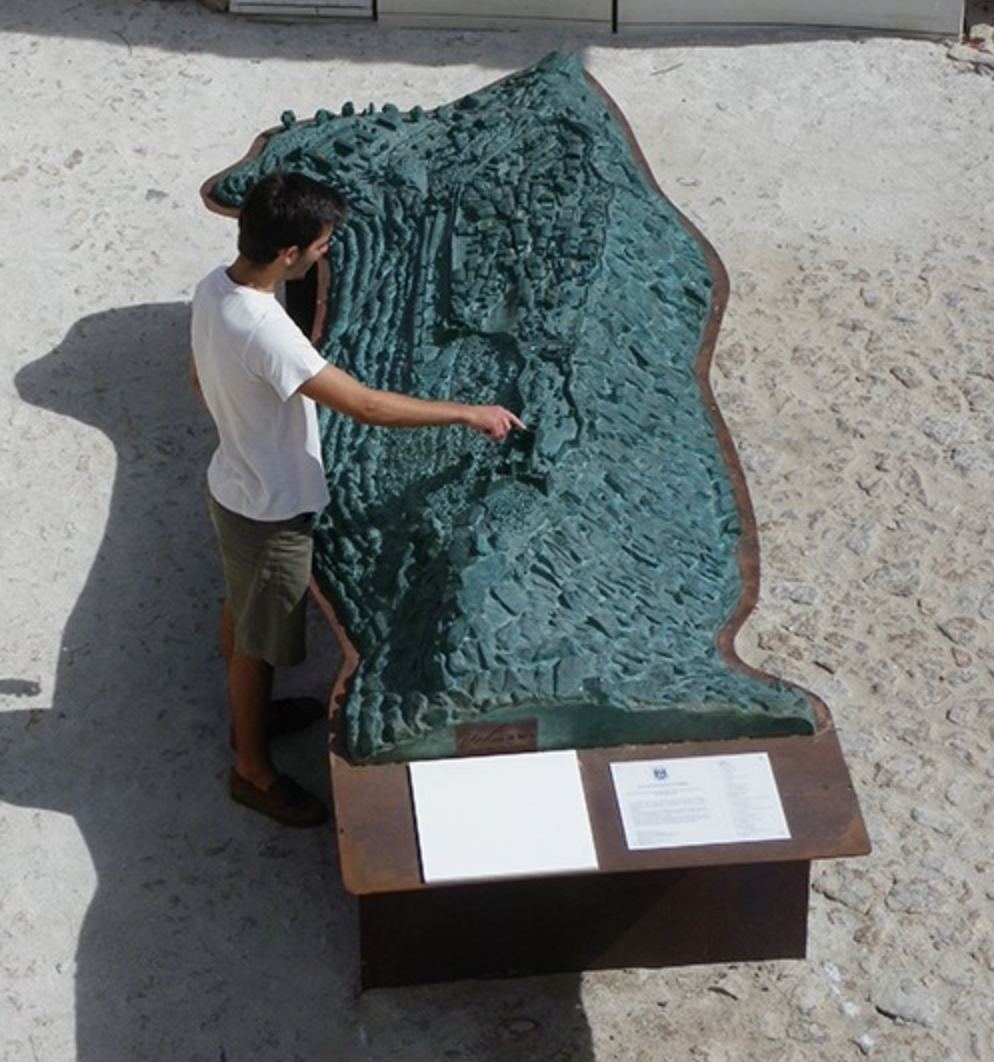
Cast model of Marvão by artist Maria Leal de Costa. photo: Maria Leal de Costa
Apart from the attraction of understanding the structure and layout of the place in minature, the model has an introductory text (also in braille) to educate the visitor:
TACTILE SCULPTURE OF THE VILLAGE OF MARVÃO
“The limits of our language are the limits of our world”
Ludwig Wittgenstein
The wall of the village of Marvão and its urban morphology merge with the quartzite escarpment, creating a joint work between nature and man, with unique characteristics.
It is the intention of the Marvão Municipal Council to abolish physical and communicative barriers in daily life, thus contributing to a world accessible to all.
Through this sculpture, conceived by the sculptor Maria Leal da Costa, tactile and visual information is transmitted, necessary for a global understanding of this exceptional heritage.
Philosophers and the Public
What’s with all this philosophy? To an American eye, this evocation of philosophers through aphoristic quotations applied to tourist destinations is welcome, albeit unusual. What do we make of it?
El cancho que se menea
In the case of Montánchez and the wobbling stone the destruction of the delicately balanced natural structure by Nationalist forces in the Civil War was certainly a case for intellectual pessimism and its re-assembly 76 years later, a cause for celebration. But it is the lack of wobble that makes this simply a work of physical reconstruction rather than an authentic restoration of the totemic fertility stone-that-wobbles that gave hope to young couples. To add to the intellectual pessimism of an unfulfilled will, it is also sobering to note that the last two sentences of the informational plaque have been rendered illegible by those who would prefer not to be reminded of this history, nor its interpretation.
Gramsci had been imprisoned by the Mussolini regime in 1926 for his political activism and affiliation with the Communist Party. This famous phrase appears in his Prison Notebooks but he had borrowed the aphorism from Romain Roland, the French idealist. Gramsci did not actually die in prison, but perished soon after his release in 1937. The prosecutor’s will that “we must stop his brain working for twenty years” was clearly not successful as the accused’s Prison Notebooks, written within that twenty year span have flourished even one hundred years after his sentence and imprisonment. In the spirit of Gramsci and the extraordinarily gifted author of the Montánchez text, the artist and historian Juan Rosco Madruga [iv], a reaffirmation of willed optimism is in order to overcome the pessimism of those who would erase history.
Marvão beyond words
In the case of the moorish fort and the evocation of Wittgenstein’s observation from the Tractatus [v], a worthy and practical if somewhat banal interpretation is spelled out in the rest of the text: a three dimensional tactile model of the fortified castillo is designed to expand the experience of the visually impaired visitor. This statement is valid but limited. On a purely philosophical level what Wittgenstein is saying is ‘our world’ only exists if we have the language to describe it. It is ironic that this particularly physical metaphor used by Wittgenstein has been invoked in a walled and fortified town that is quite literally defined by ‘die grenzen’, boundaries in stone. Another irony is that an artist and sculptor — someone who communicates in media other than words — cites what is on a narrow interpretation, an essentially linguistic observation. The “limits of our language” as a phrase is vastly expanded if one includes the many languages of sensorial expression such as in music and visual and dramatic art. There are no words for the feelings evoked by a Schubert piano sonata, nor for the beauty of Cellini’s Perseus. It is not a coincidence that Marvao is a center for the arts. It is a place beyond words.
As news from the outside world leads us into the abyss of intellectual pessimism, Marx was right to complain that philosophers have only interpreted the world [vi]. If the point is to change it we have our guides in Gramsci and Señor Rosco to remain optimistic.
HM 22 Aug 2026
Postscript, 24 August 2026
Having visited ‘el cancho que se menea’ on the ridge of the Montánchez sierra many times in the past, I had not been there in recent years. It was a wildfire not so far away last night that inspired me to climb up again to see what progress the planes and helicopters were making in controlling the blaze and to refresh my memory of the beloved stone. I can report that by sundown the firefighters had got the blaze under control.
On the other hand I was interested to see that the explanatory text for the visitor to ‘the stone that wobbles’ had been changed. There is an expansion of the documentation — and attributions — from 1904; the “brutal and savage act” in the destruction of this object of reverence in the “fratricidal war” remains; but there is no reference to “ignorance and barbarism” nor any mention of Gramsci, optimism, pessimism or any other invocation to keep our spirits up. The prosecutor in Gramsci’s trial seems to have scored a point and perhaps (invoking Wittgenstein) the limits of the Montánchez world may have been tightened a notch but the limitless glory of a summer evening on the sierra remains beyond words.
[i] Tirso Lozano Rubio was a priest, canonical teacher and ecclesiastical judge as well as being a local historian. Born in Montànchez in 1865, he died in Badajoz in 1938. The city had fallen to Nationalist forces in 1936.
[iii] https://marialealdacosta.com/en/home-english/
[iv] Juan Rosco Madruga, born in Montánchez, was an artist and historian. Beyond his own artistic accomplishments, he and his wife recognized and put on the map the 6th century Visigothic basilica in neighboring Alcuescar. He also discovered and interpreted the rock formations in Los Barruecos as being a solar observatory dating back 4,500 years. https://www.hoy.es/caceres/maravilloso-visionario-dislexico-juan-rosco-madruga-20201129190254-ga.html
[v] https://en.wikipedia.org/wiki/Tractatus_Logico-Philosophicus
[vi] “The philosophers have only interpreted the world, in various ways. The point, however, is to change it”. Karl Marx, Eleven Theses on Feuerbach.
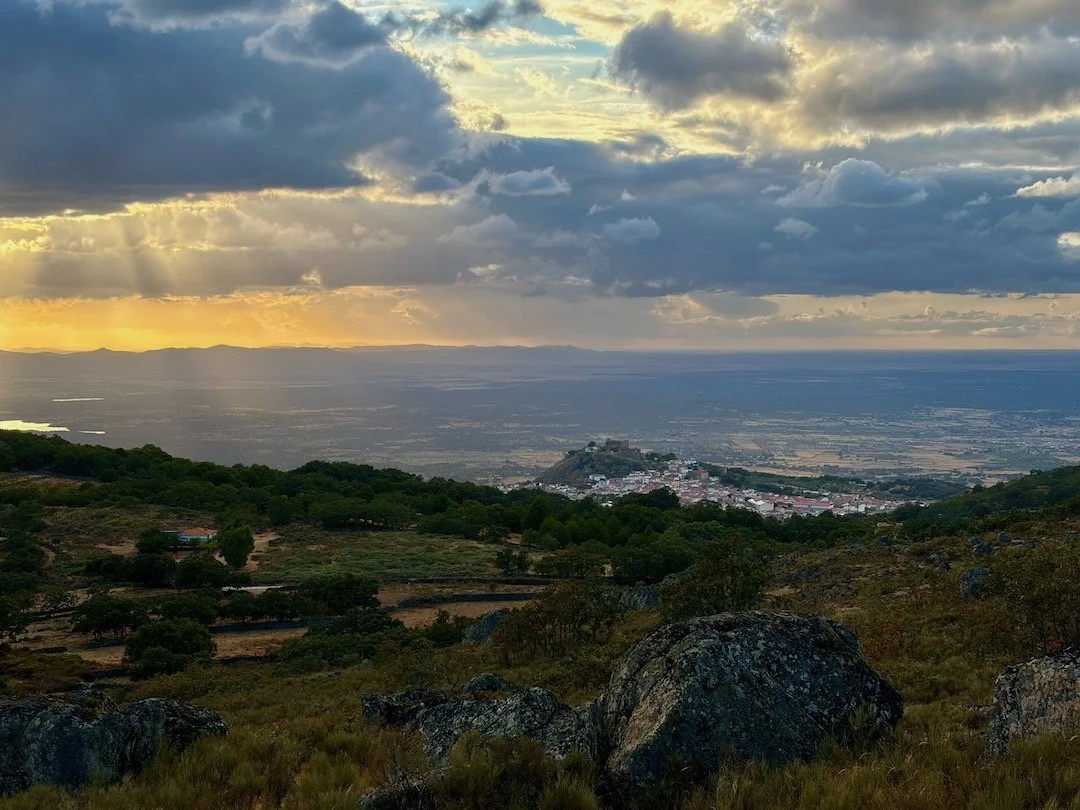
The town of Montánchez from the Sierra photo: Hubert Murray
First published on Medium, August 24, 2026